Comparison (why the Para usually wins)
Executive summary
Both are 25-frame circulators with G 1½ unions, but they’re built on different philosophies. Para 25/8-75/SCU is an ECM (high-efficiency) pump with smart Δp-v / Δp-c / n-constant control and ultra-low standby, aimed at low head-loss modern loops. Star-RS 25/60-180 is the classic 3-speed asynchronous pump that holds a fixed speed once you set it. In variable-flow appliances and short distribution loops, the Para’s control and efficiency almost always deliver a quieter system and lower kWh.
Where each pump fits
-
Para 25/8-75/SCU: OEM and site installs with genuinely low head-loss (HIUs, compact boilers, appliance modules) where stability, quietness, and energy are priorities. Built-in Δp controls let the pump adapt as valves modulate.
-
Star-RS 25/60-180: Legacy or simple loops that run at a fairly constant condition, or high-temperature replacements where a fixed 3-speed is acceptable and the system doesn’t need differential-pressure control. Official RS technical data lists IP44, 1~230 V/50 Hz, max P1 around 99 W depending on speed/impeller.
Motor & control philosophy (why ECM matters)
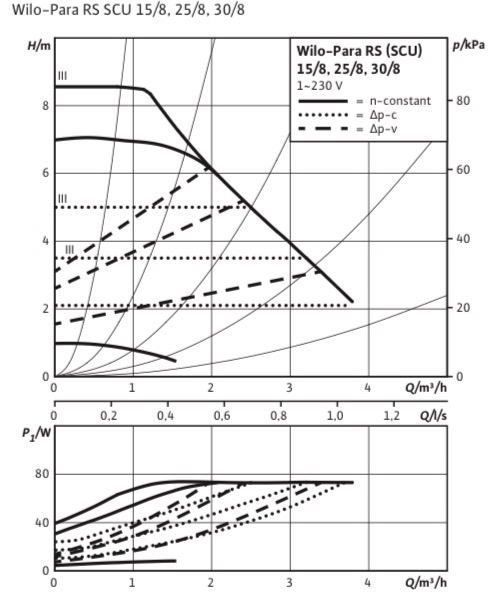
Para uses an electronically commutated motor (ECM) with self-controlled modes selectable at the pump:
- Δp-v (proportional differential pressure) — automatically reduces head as flow falls to tame valve noise and save energy.
- Δp-c (constant differential pressure) — holds pressure across branches as demand changes.
- n-constant I/II/III — fixed speed when a specification insists on it.
These are set via a green push-button with a LED UI.
Star-RS is a 3-speed asynchronous pump: pick speed I/II/III at commissioning; it stays there. This is simple, but it doesn’t self-adapt to part-load valve positions—exactly where many modern loops spend their life. Wilo’s RS pages describe the series as a standard pump with three preselectable speed stages and IP44 motor.
Takeaway: In variable-flow, low-head circuits, Δp-v on the Para keeps emitters quiet and avoids over-pumping; a fixed-speed RS can’t.
Efficiency & power budget (with real numbers)
Para 25/8-75/SCU is rated EEI ≤ 0.21, with P1 = 4…75 W and ≤ 0.5 W standby; approvals CE/EAC/UA, IPX4D, Class F insulation. That’s tailor-made for appliances with tight energy and standby targets.
Star-RS 25/60-180 typical data shows P1 ≈ 43 / 61 / 84 W at speeds I/II/III (datasheet), max up to about 99 W in some product pages; IP44; Class F.
What this means in practice: If your loop averages, say, 35 W less with the Para (very plausible at part-load), 3,000 h/year saves ~105 kWh/year—and you also cut valve hiss and call-backs because pressure backs off automatically.
Operating envelope & cavitation guard
Para 25/8-75/SCU limits: fluid −10…95 °C, ambient −10…70 °C, PN 10. Minimum suction head at the suction port to avoid cavitation: 0.5 m @ 50 °C and 4.5 m @ 95 °C. Note: very hot fluid/ambient can affect hydraulic performance (allow margin near limits).
Star-RS 25/60-180 extends to −10…110 °C (at +40 °C ambient), PN 10. Its datasheet gives the inlet (minimum suction head) rule of 0.5 m @ 50 °C, 3 m @ 95 °C, 10 m @ 110 °C. That extra top-end temperature can help in certain legacy boiler circuits—provided you can ensure the much higher suction head at 110 °C.
Installation & service experience
Para is OEM-friendly: front-access to the signal connector and screws (integrated PR60-61 3-way), compact standardized geometry (DN25 in 130 mm or 180 mm bodies), air-venting, manual restart, and factory reset baked in—great for tight housings and fast line-builds.
Star-RS mounts at 180 mm length in the 25/60 size, with the familiar terminal box and PG11 threaded cable gland; terminal box can be rotated to 3/6/9/12 o’clock—simple and familiar for replacement jobs.
Materials & durability
Both use a proven heating-water stack: grey cast-iron housing, PP-GF40 impeller, stainless-steel shaft, carbon bearings (Para cast-iron variants additionally note cataphoresis treatment). Follow VDI 2035 water chemistry, and if you run glycol, re-check curves >20 % due to viscosity.
Spec table (side-by-side)
|
Spec |
Para 25/8-75/SCU |
Star-RS 25/60-180 |
|
Motor/control |
ECM; Δp-v / Δp-c / n-const I-III; LED UI |
Asynchronous; 3 speeds (I/II/III) |
|
Supply |
1~230 V, 50/60 Hz |
1~230 V, 50 Hz |
|
Efficiency / power |
EEI ≤ 0.21; P1 4–75 W; ≤ 0.5 W standby |
P1 ≈ 43/61/84 W (speeds I/II/III); up to ~99 W on some listings |
|
Protection / class |
IPX4D, Class F |
IP44, Class F |
|
Fluid temp / ambient |
−10…95 °C / −10…70 °C |
−10…110 °C / (at +40 °C ambient) |
|
Min. suction head |
0.5 m @ 50 °C; 4.5 m @ 95 °C |
0.5 m @ 50 °C; 3 m @ 95 °C; 10 m @ 110 °C |
|
Ports / length |
G 1½, 130 mm or 180 mm bodies |
G 1½, 180 mm body |
Sources: Para datasheet; RS datasheet and Wilo product pages.
How to “translate” an RS setup to Para (practical migration)
- Record current RS duty: speed setting + observe valve behavior/noise.
- Start Para in Δp-v at a mid set-point. This reduces head automatically as valves close; check emitters for quiet operation.
- Fine-tune: if parallel branches need steadier pressure, try Δp-c; if a spec demands fixed, use n-constant I/II/III and match the resulting curve.
- Purge and protect: run air-venting, then verify minimum suction head at your operating temperature (esp. ≥ 80 °C).
- Lock settings and document the final mode for O&M.
Why choose
Para 25/8-75/SCU
(the short case)
- Adaptive hydraulics suit modern, low-head loops — less hiss, fewer call-backs.
- Lower kWh and standby — EEI ≤ 0.21, 4–75 W, ≤ 0.5 W idle — a big deal in appliances.
- Faster commissioning/service — green button + LED UI, front-access PR60-61, and air-venting/restart/reset on board.
- Clean drop-in geometry — same DN25 unions; choose 130 mm or 180 mm bodies to standardize across platforms. r-RS 25/6 curves are included in its PDF).
Unless your system truly needs >95 °C fluid operation (and you can satisfy the much higher inlet head that entails), the Para 25/8-75/SCU is the smarter 2025 choice for 25-frame circulators: quieter modulation, lower energy, and faster commissioning — designed for exactly the low head-loss loops that dominate modern hydronics.