Solar Water Heater in Qatar Thermosiphon Essentials, Sizing & Real-World Benefits
Hot Water from the Sun, Built for the Gulf.
We are authorized Cosmo Solar dealers in Qatar, supplying and supporting thermosiphon systems.
Why Thermosiphon?
Simple, proven, low-maintenance
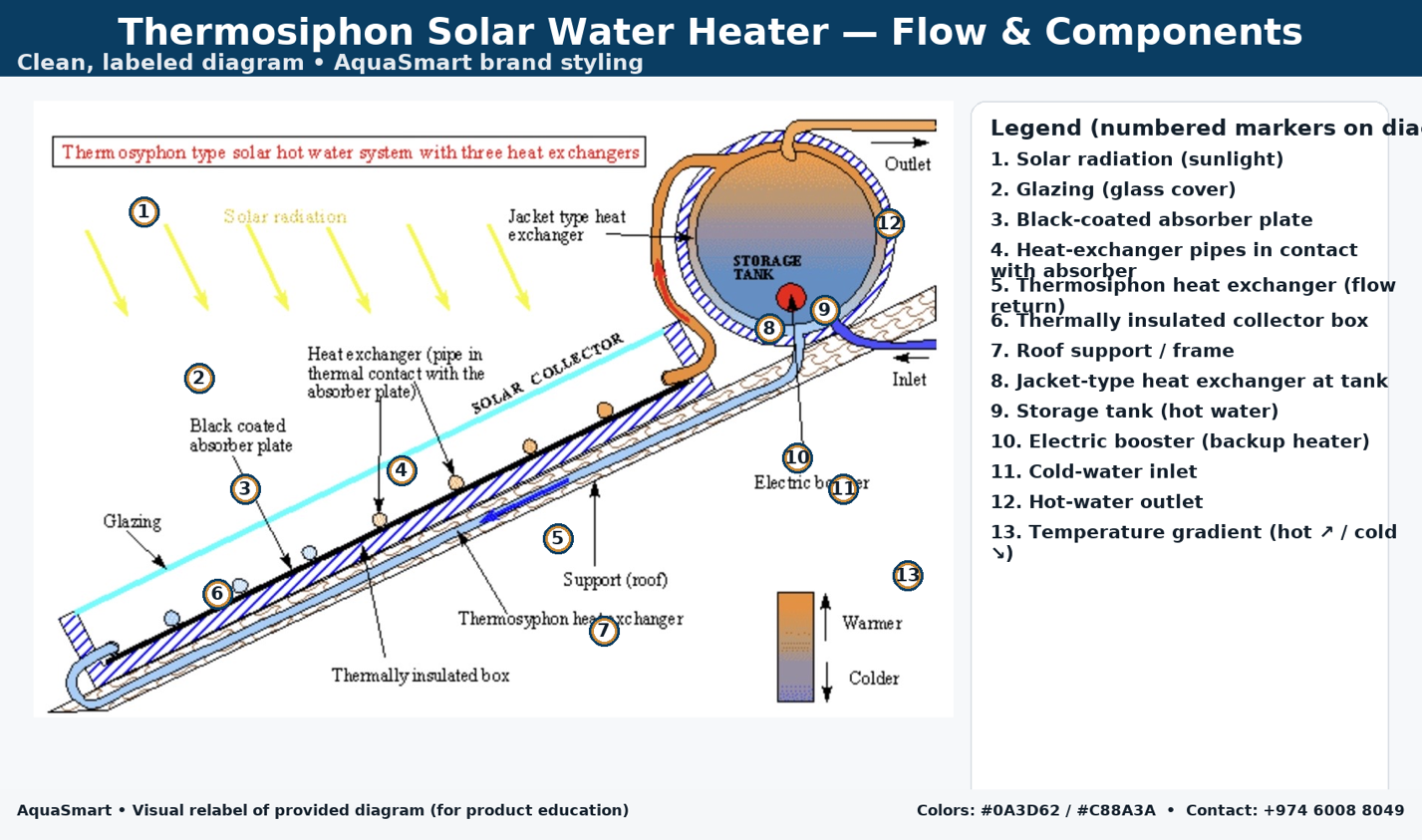
A thermosiphon solar water heater warms water in roof-mounted solar collectors and stores it in a tank above the panels. Hot water naturally rises into the tank and cooler water returns to the collector—so no pump or controller is needed. Fewer moving parts means high reliability, low upkeep, and silent operation. In Qatar’s strong sun and warm mains water, thermosiphon delivers excellent performance for homes and small businesses at a very attractive running cost.
What this product provides
- Lower bills: The sun does most of the work, so your electricity use drops.
- Reliable hot water: Day after day, with simple, sturdy hardware.
- Built for the Gulf: Frames, glazing, and tanks prepared for heat, dust, and hard/saline water.
- Fits any home: From compact apartments to large villas and staff housing.
solar water heater
Product identity & materials
- System type: Thermosiphon (passive circulation), factory 26° tilt frame.
- Tank choices: Glass-lined (enameled) steel with a serviceable anode, or stainless-steel tanks for extra corrosion resistance.
- Collectors: Flat-plate solar collectors with selective coating (better absorption), low-iron tempered glass, and aluminum frames.
- Piping: Insulated, UV-stable hot-water lines for long life on exposed roofs.
- Safety: Thermostatic mixing valve for safe tap temperatures; T&P relief to drain.
Models we supply in Qatar
-
In Stock (Glass-Lined):
-
EGLK200/2.00-26° — 200 L tank + ~2.0 m² collector (great for 2–3 people)
-
EGLK300/4.00-26° — 300 L tank + ~4.0 m² collectors (great for 3–5 people)
-
-
Special Request (Made/On Order):
-
Glass-Lined: 150 L, 500 L, 1000 L sets
-
Stainless-Steel: 150 L, 200 L, 300 L, 500 L, 1000 L sets
-
ore bathroos or simultaneous showers.
How to size it
Quick rule of thumb: Match storage to collector area at about 75–100 liters per square meter.
- Warmer mains (Qatar) = you can use the higher end of that ratio.
- Early morning, many showers together = consider more collector area.
Capacity vs. Family Size (guide)
|
Household size |
Typical daily use |
Suggested model |
|
1–2 people |
1–2 showers + kitchen |
200 L / ~2 m² (EGLK200) |
|
3–4 people |
2–4 showers + kitchen + laundry |
300 L / ~4 m² (EGLK300) |
|
5–6 people |
4–6 showers + higher demand |
300–500 L / ~4–6 m² (special request) |
|
6+ / villas & staff housing |
Multiple bathrooms, utility blocks |
500–1000 L / ~6–12 m² (special request) |
We’ll confirm the best size after a short chat about bathrooms, shower habits, and roof space.
Efficiency
- Year-round output: Frames set around 26° suit Doha latitude for balanced winter/summer performance.
- High solar gain: Selective coating, low-iron glass, and solid insulation help the system keep heat even during breezy winter days.
- Smart safety: A mixing valve blends hot water before it reaches your taps, so you enjoy steady, comfortable 45–50 °C delivery—even when the tank is hotter.
GL vs. SS tank: which is right for you?
-
Glass-Lined (GL): Best value. Great durability when the sacrificial anode is checked or replaced each year.
-
Stainless-Steel (SS): Extra corrosion resistance—popular near the coast or for users who prefer minimal internal coatings. Available by special request.
If your water is very hard/saline, we can suggest simple additions (like a small treatment cartridge) and a maintenance plan to keep performance strong.
Real-world installation basics (plain and simple)
-
Sunny roof space: Point south (±15° is fine) and keep the panels unshaded 9am–3pm.
-
Short, insulated pipes: Hot pipe goes up to the tank; cold return goes down to the collectors—no dips or traps.
-
Safe plumbing: Mixing valve at the outlet; relief valve to drain; if a non-return valve is used on the cold feed, add a small expansion vessel.
-
Easy care: Rinse the glass after dust storms (cool mornings), and do a quick visual once or twice a year.
Simple cost comparison why people switch?
Most homes using electric heaters see hot-water costs fall dramatically after switching to solar assist. With thermosiphon, the sun does the heavy lifting, while a small electric backup (if you choose it) only tops up on cloudy spells or very late-night use.
Key features
Free sun power, lower bills: Solar delivers most daily hot water in Qatar.
-
Reliable & quiet: No pump, few parts, easy to look after.
-
Built for GCC: Tough glazing, insulated tank, UV-stable lines.
-
Sized for any home: 150–1000 L options; EGLK200/2.00 and EGLK300/4.00 in stock.
FAQs
1) Do I need an electric backup?
Short answer: Optional—but smart to have.
When it helps:
-
Cloudy/windy winter days (rare, but happen).
-
Late-night or early-morning peak after a big evening use (guests, laundry).
-
Vacations/returns: quick “recovery” after the system has been idle or covered.
How to set it up right (so it doesn’t waste power):
-
Size: 1.5–2.0 kW for 200 L; 2.0–3.0 kW for 300 L.
-
Control: Use a timer (e.g., 05:00–07:00 only) or keep its thermostat set a few degrees below the solar target, so it tops up, not competes.
-
Safety & wiring: Dedicated breaker, RCD/RCBO, proper earthing, and a manual reset thermal cut-out. Roof spaces run hot—use cable/conduit rated for temperature and UV.
Pro tip: If your showers are mostly evenings, you’ll use the element very little. Morning-heavy homes may use it more in winter.
2) Is it safe for kids and elders?
Yes—when installed with a mixing valve (TMV).
-
What it does: Blends hot water from the tank with cold water to deliver a steady 45–50 °C at taps.
-
Why it matters: On sunny days the tank can exceed 60–70 °C; without a TMV, that’s a scald risk.
-
Where it goes: At the tank outlet feeding the home’s hot line (not only at one bathroom).
-
Maintenance: Service or replace cartridges if flow becomes uneven or temperatures fluctuate—scale can stiffen the valve over time.
Extra safety: Keep the T&P relief valve intact and piped to drain; never cap it. If you add a check valve on the cold feed, add a potable expansion vessel to absorb thermal expansion and prevent drips.
3) How long does it last?
Typical life: 10–15+ years with basic care; many run longer.
What determines lifespan:
-
Water quality: Hard/saline water increases scale and corrosion—plan simple treatment (polyphosphate or softener where needed).
-
Anode care (glass-lined tanks): Check/replace the magnesium or Al-Zn anode annually; it sacrifices itself so the tank doesn’t.
-
Roof & piping: UV-stable insulation, tight anchors, and short runs reduce stress and heat loss.
Low-effort maintenance plan:
-
Every 6–12 months: Visual check, rinse dusty glass (cool mornings), test T&P lever, confirm TMV setpoint (~49–50 °C).
-
12 months: Inspect/replace anode (GL tanks), clean strainers, re-torque roof fasteners.
-
24 months: Descale hot-water path if your area is very hard; inspect dielectric unions.
-
After sandstorms: Quick rinse of glazing; check frame and fixings.
Warranty (typical, varies by brand): Tank 5–7 years against leakage (with anode records), collectors ~5 years, valves/accessories 1–2 years.
4) Can I use stainless-steel?
Yes—stainless-steel (SS) tanks are available by special request.
When SS makes sense:
-
Coastal/very saline areas or if you prefer minimal internal coatings.
-
Lower-maintenance preference: No anode to check (still inspect the system).
What to know before choosing SS:
-
Grade matters: Ask for a grade suitable for hot potable water in chloride environments (e.g., 316L or equivalent per the manufacturer).
-
Still needs good practice: Use dielectric unions to avoid galvanic corrosion; keep lines insulated; follow the same safety rules (TMV, T&P, expansion).
-
Cost/lead time: Usually a premium over glass-lined and supplied on special request; confirm lead time at order.
When glass-lined (GL) is ideal:
-
Most inland Doha/Lusail homes do very well with GL tanks if the anode is serviced yearly—great performance per riyal.
Will it work on cloudy days?
Yes—output drops with weak sun, but a correctly sized system still covers part of demand. The backup element handles the rest when needed.
What size should I pick?
-
2–3 people: 200 L with ~2.0 m² (EGLK200/2.00).
-
3–5 people: 300 L with ~4.0 m² (EGLK300/4.00).
Use 75–100 L per m² as a rule of thumb; morning-heavy use → lean to more collector area.
How do I prevent “dripping” from the relief valve?
Add a hot-water expansion vessel if you have a check valve on the cold line; set a PRV around 3–4 bar; keep the TMV and insulation in good shape.
What’s in stock vs. special request?
-
In stock: EGLK200/2.00 (200 L) and EGLK300/4.00 (300 L).
-
Special request: 150/500/1000 L and all stainless-steel versions.
In stock today:
-
EGLK200/2.00-26° (200 L) — Ideal for 2–3 people
-
EGLK300/4.00-26° (300 L) — Ideal for 3–5 people
Available on special request: 150 L, 500 L, 1000 L, and all stainless-steel versions (200/300/500/1000 L).
Who we are?
We’re established Cosmo Solar dealers in Qatar with hands-on experience sizing, installing, and supporting thermosiphon systems across Doha, Lusail, Al Wakrah, and beyond. We keep popular models on hand, fast-track special requests, and back everything with local advice and service.
Get your best-fit system
Share your number of bathrooms, typical shower times, and a photo of your roof space. We’ll reply with a clear recommendation—tank size, collector area, and a simple estimate—so you can enjoy clean, reliable hot water from the sun.


